Peter Hemings: The Enslaved Master Brewer Whose Beer Made Jefferson Famous
Thomas Jefferson's reputation as a Renaissance man included his appreciation for fine beer. Monticello's brewing operation produced ales that impressed Jefferson's guests and reinforced his image as a cultured gentleman with refined tastes. What this narrative consistently omits: Jefferson didn't brew the beer. Peter Hemings did.
Hemings was enslaved at Monticello from birth until death. He was a master brewer whose expertise created the beers that enhanced Jefferson's reputation among Virginia's elite. Jefferson took credit for Hemings's work, profited from Hemings's skill, and never acknowledged the man whose labor made Monticello's brewery successful.
This erasure wasn't accidental. It was the deliberate structure of slavery—white enslavers received credit and profit for Black people's expertise, skill, and innovation, while the actual creators remained invisible and unpaid.
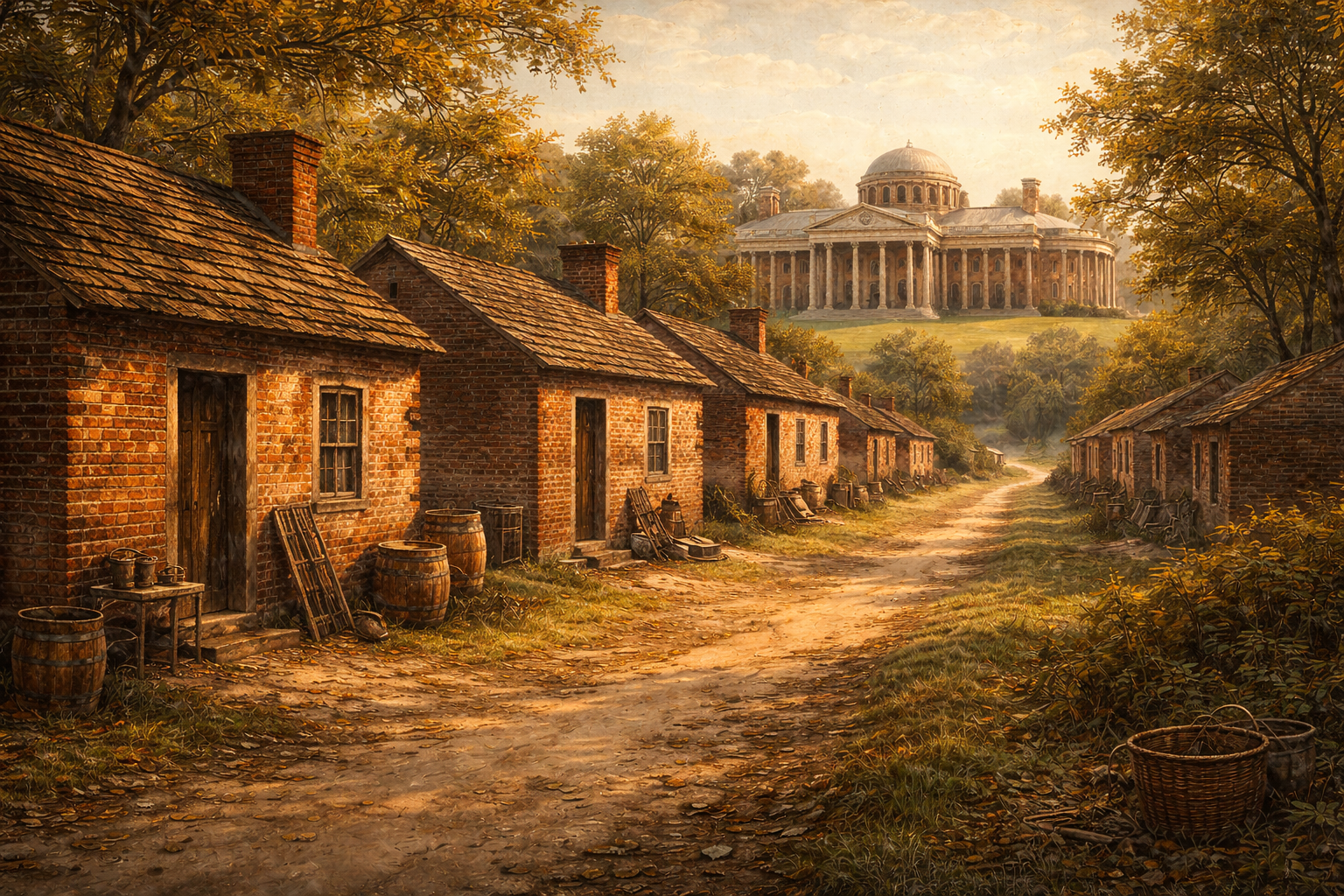
Artistic depiction of Monticello's working buildings along Mulberry Row.
The Hemings Family at Monticello
Peter Hemings was born into slavery at Monticello around 1770, one of twelve children born to Elizabeth "Betty" Hemings. The Hemings family occupied a complex position at Monticello—they were enslaved, but many family members held skilled positions that gave them slightly more autonomy than field laborers experienced. SOURCE
This "privileged" status within slavery's hierarchy was still slavery. Peter Hemings could not leave Monticello, could not refuse work assignments, could not keep wages for his labor, could not make decisions about his own life. His expertise as a brewer benefited Thomas Jefferson, not himself.
The Hemings family's story at Monticello reveals the sophisticated skills enslaved people possessed—skills that white enslavers exploited while denying the humanity and capabilities of the people they enslaved. Peter's siblings included skilled craftspeople, cooks, and artisans. Their expertise was essential to Monticello's operation and Jefferson's lifestyle, yet they received no compensation, recognition, or freedom.
Peter's relationship to the Jefferson family was particularly complex—his mother Betty Hemings was the half-sister of Jefferson's wife Martha, making Peter Hemings the nephew of Martha Jefferson and related by blood to the man who enslaved him. This familial connection didn't grant freedom or fair treatment. It simply meant Jefferson was enslaving his own relatives.
Becoming a Master Brewer
Brewing beer in the late 1700s and early 1800s required extensive knowledge and skill. A brewer needed to understand grain varieties, malting processes, hop selection, water chemistry, yeast management, fermentation temperatures, barrel aging, and dozens of other technical factors. This was sophisticated work requiring years of training and experience.
Peter Hemings developed this expertise through training and practice at Monticello. He likely learned initially from other enslaved brewers or from brewing manuals Jefferson acquired. But books could only teach so much—the real learning came through experience, through understanding how ingredients behaved, how to adjust for weather and temperature, how to troubleshoot problems.
Hemings became skilled enough that Jefferson trusted Monticello's brewing operation entirely to him. This wasn't casual beer-making. Monticello produced substantial quantities of beer—both for consumption at the estate and for Jefferson's reputation. The beer needed to be consistently good, appropriate for serving to important guests, and reflective of Jefferson's supposed refined taste.
The technical knowledge Hemings possessed was valuable. In a free market, a master brewer with his skills could earn good wages, perhaps even own his own brewery. But Hemings was enslaved, which meant Jefferson received all the value Hemings created while Hemings received nothing beyond minimal food, clothing, and shelter.
Jefferson's "Beer Expertise"
Jefferson cultivated a reputation as knowledgeable about beer and brewing. He corresponded with other gentlemen about beer styles, collected brewing equipment, and acquired brewing texts from Europe. His guests at Monticello praised the quality of the beer served there.
But Jefferson didn't brew the beer. Peter Hemings did.
Jefferson's role was instructional and supervisory at best. He might have specified which styles of beer he wanted produced, might have acquired equipment and ingredients, might have reviewed results. But the actual work—the skilled labor of brewing—was Hemings's.
This pattern repeated across every aspect of Monticello's operation. Jefferson received credit for the beautiful gardens, the fine cooking, the excellent wines, the skillful carpentry, the quality blacksmithing. But enslaved people did the actual work. Their skills and knowledge made Jefferson's lifestyle possible and enhanced his reputation, while they remained invisible. SOURCE
The dynamic reveals something crucial about how slavery operated: it wasn't just about forced labor. It was about theft of credit, erasure of achievement, and the systematic transfer of value from Black people to white people. Hemings's expertise became Jefferson's reputation. Hemings's labor became Jefferson's leisure.
The Brewing Operation at Monticello
Monticello's brewery was substantial. It wasn't a small homebrew operation—it was a production facility designed to provide beer for Jefferson's large household, his many guests, and the enslaved community at Monticello.
Hemings managed the entire operation. He sourced or supervised the growing of barley, managed the malting process, selected hops (likely grown at Monticello), maintained brewing equipment, oversaw fermentation, managed barrel aging, and ensured consistent quality across batches. This required constant attention, technical judgment, and years of accumulated knowledge.
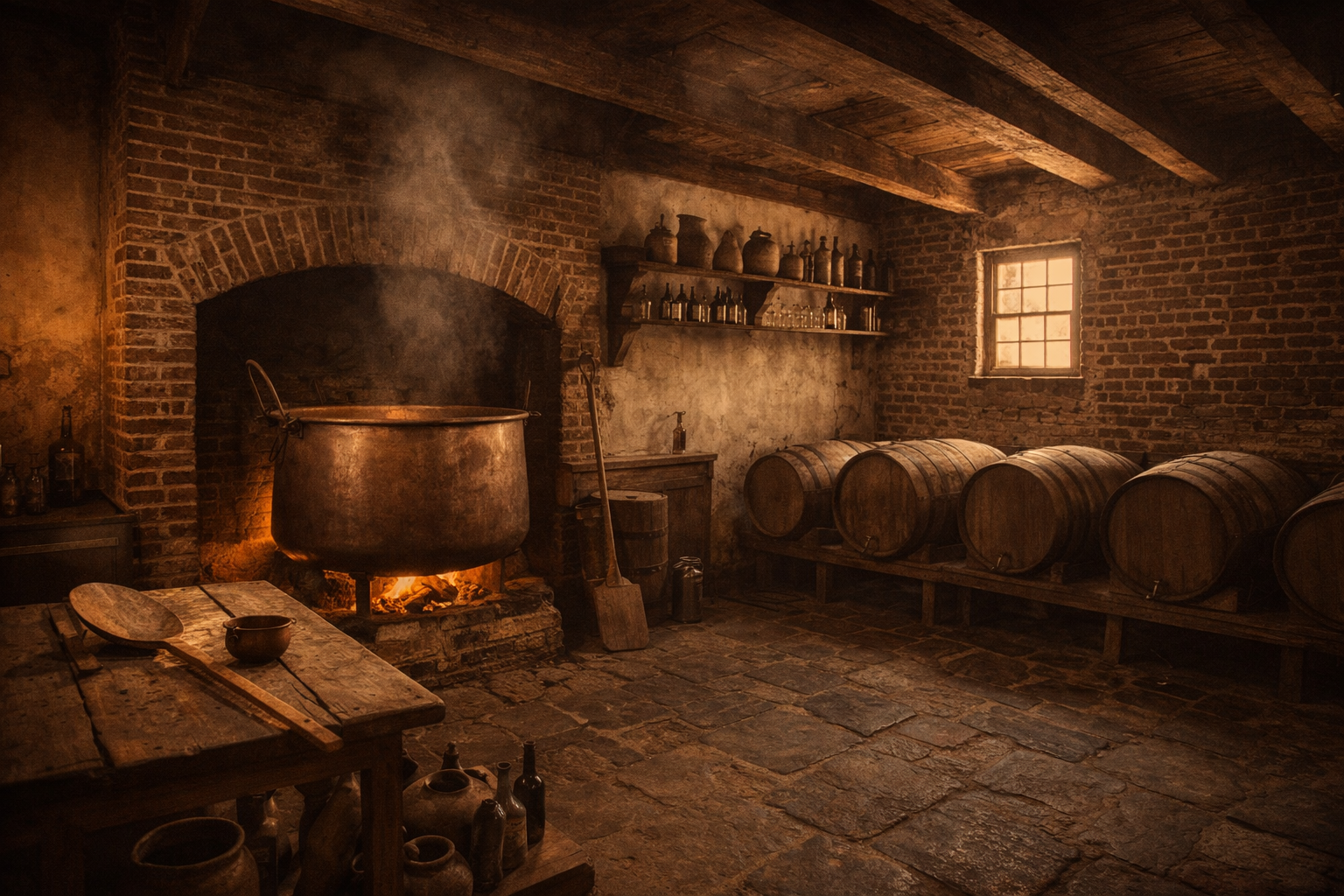
Artistic depiction of a colonial-era brewery workspace. The brewing room at Monticello required sophisticated equipment and extensive knowledge to operate. Peter Hemings managed every aspect of beer production in a workspace similar to this, creating the beers that enhanced Thomas Jefferson's reputation while receiving no compensation or recognition for his expertise.
The beer itself needed to meet high standards. Jefferson's guests included presidents, foreign dignitaries, scientists, and Virginia's wealthy elite. The beer served at Monticello reflected on Jefferson's reputation. Poor beer would have embarrassed him. Excellent beer—which is what Hemings consistently produced—enhanced his standing.
Brewing also required physical labor. Heating large quantities of water, moving heavy grain bags, cleaning equipment, managing barrels—all of this was strenuous work. Hemings provided both the physical labor and the technical expertise, while Jefferson provided only supervision and received all the credit.
The Recipes Jefferson Claimed
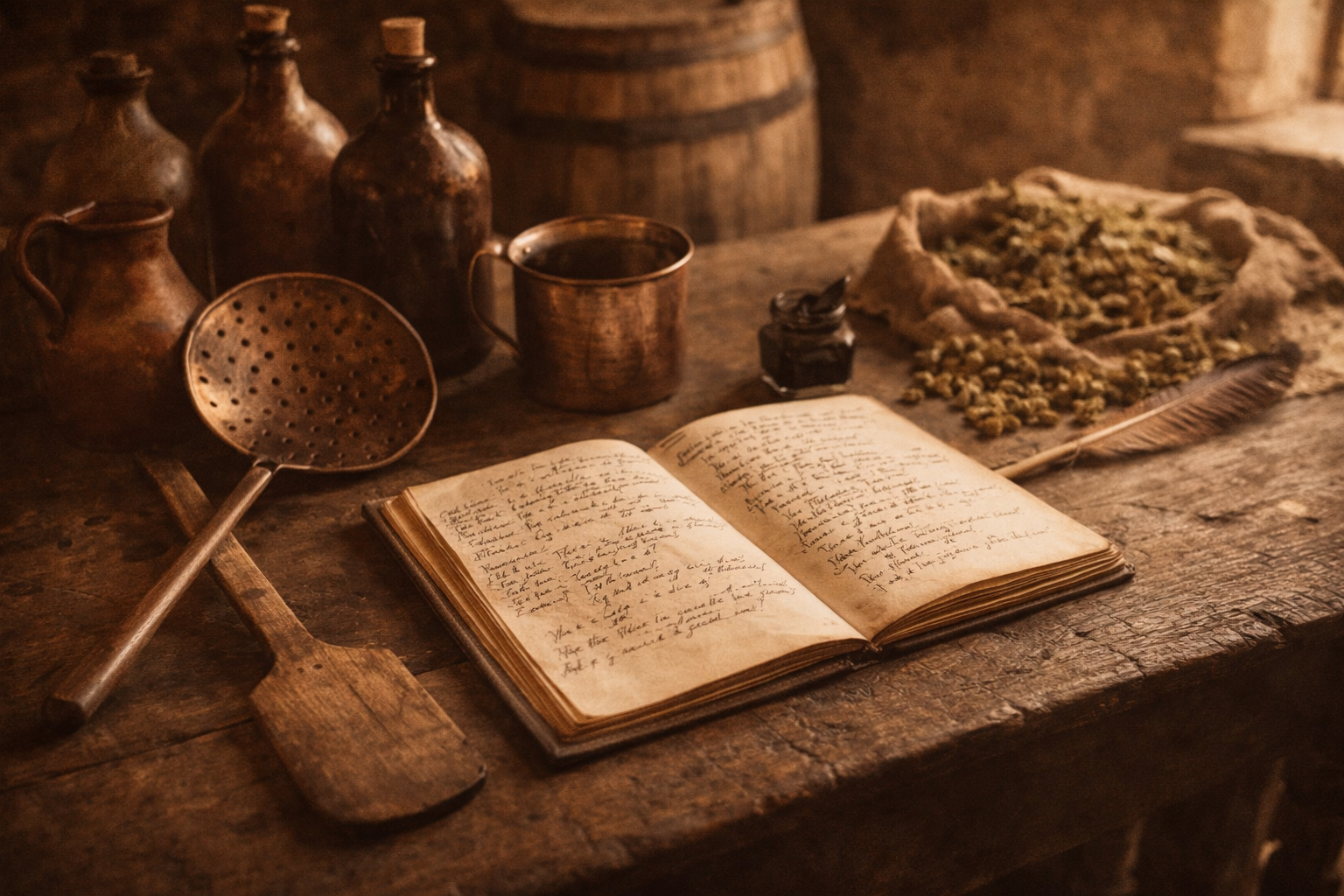
Jefferson kept brewing records and notes, some of which survive in his papers. These documents are often presented as "Jefferson's brewing recipes" or evidence of "Jefferson's knowledge of brewing." But these weren't Jefferson's recipes—they were records of what Peter Hemings produced.
When Jefferson wrote to correspondents about Monticello's beer or brewing techniques, he was describing Hemings's work. When visitors praised the beer at Monticello, they were praising Hemings's skill. But neither Jefferson's letters nor visitors' accounts acknowledged Hemings. The beer was attributed to Jefferson, as if it materialized through his refined taste rather than through Hemings's labor and expertise.
This erasure was systematic. Across Jefferson's writings about Monticello—thousands of letters, detailed records, extensive documentation—enslaved people's contributions are minimized or erased. Jefferson wrote detailed specifications about what he wanted produced, but rarely acknowledged the enslaved people whose skills made it possible.
The brewing records that survive are particularly galling because they represent Hemings's knowledge documented in Jefferson's hand. Hemings developed the techniques, learned what worked, figured out solutions to problems. Jefferson wrote it down and preserved it as his own knowledge. Hemings's expertise was literally stolen and reattributed.
The Economic Value Hemings Created
A skilled master brewer in the late 1800s could command good wages—typically $2-4 per day, which was substantial income for that era. If Hemings had been free and compensated for his expertise, he could have earned thousands of dollars over his decades of brewing work.
Instead, he received nothing. Jefferson captured 100% of the value Hemings created. The beer Hemings produced enhanced Jefferson's reputation, supplied his household and guests, and cost Jefferson only the minimal expense of keeping Hemings enslaved—basic food, minimal clothing, crude housing.
This theft of labor was replicated across every enslaved person at Monticello and across every plantation in the South. The wealth white enslavers accumulated came directly from the unpaid labor and stolen expertise of enslaved people. Jefferson's ability to live as a cultured gentleman, to entertain lavishly, to pursue his intellectual interests—all of it was financed by people like Peter Hemings whose labor received no compensation.
The economic injustice compounds when considering generational wealth. If Hemings had been paid fairly for his expertise, he could have accumulated savings, bought property, invested in his children's future. Instead, his skills enriched Jefferson while Hemings remained propertyless and unable to build any economic foundation for future generations.
Never Freed
Unlike some members of the Hemings family who eventually gained freedom, Peter Hemings remained enslaved his entire life. He died at Monticello around 1815, having spent approximately 45 years enslaved there. SOURCE
Jefferson freed only a few enslaved people in his lifetime and will—notably some of Peter's siblings and their children. But not Peter. Despite decades of skilled service, despite being related by blood to Jefferson's wife, despite creating beers that enhanced Jefferson's reputation, Peter Hemings died enslaved.
Jefferson's failure to free Hemings reveals the hollowness of Jefferson's rhetoric about human equality and natural rights. Jefferson wrote eloquently about liberty while enslaving hundreds of people. He praised individual merit and talent while exploiting Hemings's expertise without compensation or recognition. He spoke of human dignity while denying it to the man who brewed his beer.
The selective freeing of some Hemings family members while keeping others enslaved also reveals how slavery operated as a system of total control. Freedom was a gift Jefferson could grant or withhold based on his preferences, not a right Hemings could claim based on his humanity or his contributions.
The Erasure Continues
For most of American history, Peter Hemings remained invisible. Historical accounts of Monticello and Jefferson praised the estate's operations, its gardens, its fine living, without acknowledging the enslaved people whose labor made it possible. When brewing at Monticello was mentioned, it was attributed to Jefferson's knowledge and refined taste.
Even when historians began acknowledging slavery's role at Monticello more honestly, Peter Hemings often remained a footnote—mentioned briefly as "the brewer" without detailed examination of his expertise or the injustice of his erasure.
Modern Monticello has worked to correct this historical erasure, documenting enslaved people's lives and contributions more thoroughly. But the broader American narrative still tends to erase or minimize enslaved people's skills, knowledge, and achievements. We're more comfortable acknowledging enslaved people as victims than as skilled craftspeople and experts whose knowledge was stolen.
The Pattern Across Slavery
Peter Hemings's story wasn't unique. Across the South, enslaved people possessed sophisticated skills—they were blacksmiths, carpenters, masons, cooks, brewers, distillers, weavers, musicians, and experts in dozens of other crafts. Their expertise was essential to plantation operations and to enslavers' lifestyles.
But credit and compensation went to the white enslavers who owned them. An enslaved blacksmith's skill became the plantation owner's "fine metalwork." An enslaved cook's expertise became the plantation mistress's "hospitality." An enslaved carpenter's knowledge became the planter's "well-maintained estate."
This systematic theft of credit and value was central to how slavery functioned economically and ideologically. Slavery required convincing white people that Black people were inferior, incapable of sophisticated thought or skill. Yet enslavers depended entirely on enslaved people's expertise and knowledge. The solution was erasure—pretend the enslaved person's skill didn't exist, attribute achievements to the enslaver, maintain the fiction of Black inferiority while exploiting Black excellence.
Brewing and Distilling Under Slavery
Brewing and distilling were particularly valuable skills under slavery because alcohol production generated profit and enhanced enslavers' social standing. Many plantations operated breweries or distilleries, almost always managed by enslaved people whose expertise created the product.
Enslaved brewers and distillers often had knowledge passed down through generations or learned through long apprenticeships with older enslaved craftspeople. This knowledge was sophisticated—understanding grain characteristics, fermentation chemistry, flavor development, quality control. It represented real expertise that would be valued and compensated in a free labor market.
But under slavery, this expertise was simply another form of property the enslaver owned. The enslaved brewer's knowledge belonged to the enslaver just like the enslaved person's body and labor belonged to the enslaver. Peter Hemings couldn't take his brewing knowledge and start his own brewery. His skills were trapped, exploited for Jefferson's benefit until Hemings died enslaved.
The Prohibition Connection
Understanding Peter Hemings's story adds context to Prohibition's later attack on alcohol production. When Prohibition advocates targeted saloons and breweries in the early 1900s, they were continuing a pattern of denying Black people economic opportunities in alcohol production.
During slavery, enslaved people like Hemings possessed brewing expertise but couldn't profit from it or receive recognition. After slavery, Black entrepreneurs who tried to enter brewing, distilling, or saloon ownership faced systematic barriers. Prohibition then eliminated even those limited opportunities, shutting down Black-owned establishments while providing exceptions and loopholes for white-owned businesses.
The throughline is clear: whether enslaved or free, Black Americans' expertise in alcohol production was exploited, erased, or eliminated by white-controlled systems. Hemings's stolen credit under slavery prefigured Prohibition's stolen opportunity for Black brewers, distillers, and saloon owners.
What Recognition Would Have Meant
Imagine if Jefferson had acknowledged Peter Hemings's skill. If correspondence about Monticello's beer credited Hemings as the brewer. If visitors learned that the excellent beer they enjoyed was created by Hemings, not Jefferson. If brewing records documented "Peter Hemings's techniques" rather than "brewing at Monticello."
This acknowledgment wouldn't have freed Hemings or compensated him fairly—those would require ending slavery entirely. But it would have created a historical record of his achievement. His expertise would be known. His name would be remembered. The connection between his skill and Monticello's beer would be clear.
Instead, Hemings remained invisible. His knowledge was documented as Jefferson's knowledge. His achievement was recorded as Jefferson's success. Even his name rarely appears in Jefferson's extensive papers, despite Hemings working at Monticello for decades.
This erasure was deliberate. Acknowledging enslaved people's expertise threatened slavery's ideological foundation. If enslaved people were recognized as skilled, intelligent, and capable of sophisticated work, it became harder to justify enslaving them. So their achievements had to be erased, attributed to enslavers, or dismissed as simple labor rather than skilled craft.
Recovering the Story
Modern historians and researchers at Monticello have worked to recover Peter Hemings's story and acknowledge his role in Monticello's operations. Archaeological evidence, documentary analysis, and examination of brewing records have revealed more about Hemings's work and expertise.
But much is lost. We don't have detailed accounts of Hemings's brewing techniques in his own words. We don't know how he learned, what innovations he developed, what challenges he overcame. We don't know his thoughts about his work, his feelings about creating beers that enhanced his enslaver's reputation while he received nothing.
What we do know is sufficient to recognize the injustice. Peter Hemings was a master brewer whose skill created beers celebrated in his time. Thomas Jefferson received credit and benefit from Hemings's expertise. Hemings received neither compensation, recognition, nor freedom. This wasn't an unfortunate oversight—it was slavery operating exactly as designed.
The Legacy
Peter Hemings died around 1815, leaving no descendants who could claim his legacy or inherit the wealth his labor created. His expertise died with him—not because it couldn't have been taught to others, but because enslaved people's knowledge was systematically devalued and erased.
Jefferson lived sixteen more years after Hemings died, continuing to benefit from Hemings's brewing knowledge and from the labor of other enslaved people. Jefferson died in debt, ironically, which meant the enslaved people he still owned were sold to pay his creditors. The wealth Hemings and others created for Jefferson couldn't even keep Jefferson solvent, yet Jefferson lived comfortably for decades while Hemings lived and died in slavery.
The contrast reveals slavery's economic irrationality. Hemings's brewing expertise, if properly valued and compensated, could have made both Hemings and Jefferson prosperous. Instead, slavery's structure meant Jefferson extracted maximum value from Hemings while compensating him minimally, yet still accumulated debt. The system wasn't economically efficient—it was designed to maintain white supremacy and control, even when that control came at significant economic cost.
Remembering Accurately
When we talk about Thomas Jefferson today, we should talk about Peter Hemings. When we discuss Monticello's operations, we should name the enslaved people whose skills made it function. When we celebrate early American brewing traditions, we should acknowledge that many were created by enslaved brewers whose expertise was stolen and whose names were erased.
Peter Hemings was a master brewer. His skill created beers that impressed Virginia's elite and enhanced Thomas Jefferson's reputation. He possessed sophisticated knowledge developed through years of practice and experience. He deserved compensation, recognition, and freedom. He received none of these.
This isn't a story about a generous enslaver who taught a skill to an enslaved person. It's a story about systematic theft—of labor, of credit, of economic value, of human dignity. Jefferson didn't make Hemings a brewer. Hemings made Jefferson's brewery successful. Jefferson profited. Hemings remained enslaved.
When prohibition advocates later claimed that closing saloons would help Black communities, they ignored stories like Peter Hemings's. Black people had extensive expertise in alcohol production—expertise that slavery had exploited and erased. Prohibition continued that pattern, eliminating opportunities for Black entrepreneurs in brewing and distilling while white-owned businesses found ways to continue operating.
The throughline from slavery to Prohibition to modern inequality is clear: systems that benefit white Americans while restricting Black Americans' economic opportunities didn't appear by accident. They were deliberately constructed and maintained. Peter Hemings's stolen expertise was an early example of a pattern that continues in different forms today.
The Beer We Should Remember
The beers Peter Hemings created are gone. The recipes survive only as Jefferson's notes, not Hemings's own documentation. The brewing knowledge Hemings developed died with him, uncompensated and unacknowledged.
But the injustice should be remembered. Every time someone praises Thomas Jefferson's cultural sophistication, we should ask: whose labor made that sophistication possible? Every time Monticello is celebrated as an example of refined American living, we should ask: at what human cost? Every time we discuss early American brewing history, we should ask: whose expertise has been erased?
Peter Hemings deserves to be remembered as a master brewer—skilled, knowledgeable, and systematically robbed of recognition and freedom. His story isn't a footnote to Jefferson's biography. It's a central truth about how slavery operated and how American history has been told to minimize and erase Black people's contributions.
When we drink craft beer today and celebrate brewing tradition, we should remember Peter Hemings and the countless other enslaved brewers whose expertise shaped American brewing but whose names we'll never know. Their skill deserved recognition. Their labor deserved compensation. Their humanity deserved freedom. They received none of these, and that theft is part of American history that shouldn't be forgotten.