When the Church Allied with the Klan - The Dark Partnership Behind Prohibition
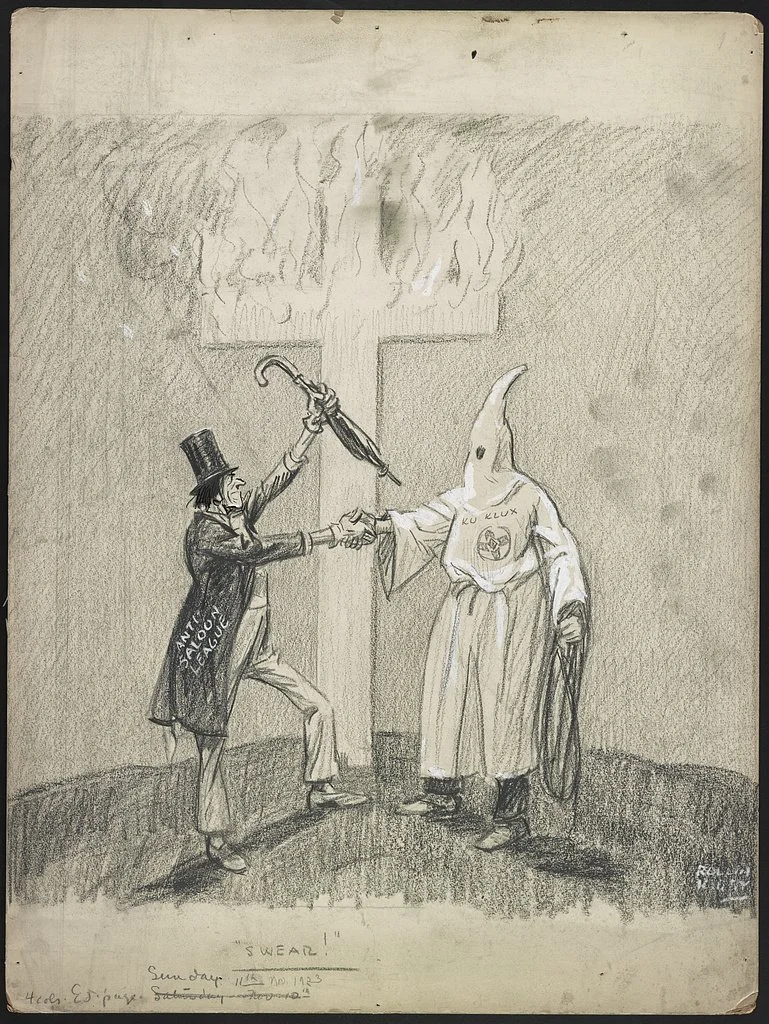
"Swear!" Political cartoon by Rollin Kirby, 1923. Library of Congress Prints and Photographs Division. No known restrictions on publication. https://www.loc.gov/item/2016682737/
The Anti-Saloon League is remembered as a religious temperance organization that successfully lobbied for Prohibition. What's conveniently left out of most history books is the League's strategic partnership with the Ku Klux Klan, and how both groups weaponized alcohol laws to terrorize Black Americans, Catholics, and immigrants.
Clarence Darrow, the famous attorney who defended John Scopes in the Monkey Trial, put it bluntly when speaking to a Baltimore Evening Sun reporter in 1924: "I would say not every anti-saloon leaguer is a Ku Kluxer, but every Ku Kluxer is an anti-salooner." SOURCE
The alliance wasn't accidental. It was strategic, brutal, and devastatingly effective.
The 1906 Atlanta Race Riots Changed Everything
Before 1906, Prohibition hadn't gained serious traction in the South. That changed after white mobs in Atlanta, fueled by fabricated newspaper reports of Black men attacking white women, descended on the city's Black neighborhoods. Over several days in September 1906, more than twenty Black Georgians were killed, hundreds injured, and countless Black-owned businesses destroyed—including saloons. SOURCE
White Atlanta newspaper publishers and gubernatorial candidates Hoke Smith and Clark Howell had spent months inflaming racial tensions through their papers, the Atlanta Journal and Atlanta Constitution. According to the New Georgia Encyclopedia, they attacked saloons and bars owned and frequented by Black citizens, calling them "dives" and falsely claiming they displayed nude pictures of women. These establishments were blamed as "the root cause" of the supposed attacks, despite the reports being entirely false. SOURCE
White residents had been increasingly anxious about Atlanta's growing Black middle class, particularly successful Black entrepreneurs who owned saloons and other gathering places. The massacre provided the pretext they needed.
Between 1907 and 1909, five Southern states—Oklahoma, Georgia, Mississippi, North Carolina, and Tennessee—went dry. These weren't coincidental temperance victories. They were Jim Crow laws designed to accomplish three specific goals: shutting down Black-owned businesses, closing Black community gathering spaces, and providing legal pretexts for harassing Black men.
"In Alabama, It's Hard to Tell Where the Anti-Saloon League Ends and the Klan Begins"
By the 1920s, the relationship between the Anti-Saloon League and the KKK was undeniable. A local Alabama newspaper editor observed that "In Alabama, it is hard to tell where the Anti-Saloon League ends and the Klan begins." SOURCE
The partnership made tactical sense for both organizations. The Anti-Saloon League, a church-based political pressure group, needed enforcement muscle that overwhelmed federal agents couldn't provide. The KKK needed legitimacy and a legal framework to conduct raids on communities they wanted to terrorize.
When an Alabama state senator proposed an anti-masking statute to prevent the Klan from terrorizing people, J. Bib Mills—superintendent of the Alabama Anti-Saloon League—lobbied successfully to kill the bill. SOURCE The League valued its Klan partnership more than protecting citizens from domestic terrorism.
At the national level, the Anti-Saloon League publicly tried to maintain distance from the Klan's most extreme rhetoric. League leaders Wayne Wheeler and Ernest Cherrington claimed to operate nonpartisan bureaucratic operations. But locally, the collaboration was explicit and often violent. One Illinois pastor admitted that while he had been "accustomed to working through the Anti-Saloon League," the Klan now provided "a more militant vehicle" for enforcement. SOURCE
The Williamson County Bloodbath
The most horrific example of this partnership played out in Williamson County, Illinois, starting in December 1923. The federal Prohibition Bureau, desperately under-resourced, began deputizing KKK members as official enforcement agents. SOURCE
S. Glenn Young, a former Prohibition agent who had been fired for killing a suspect and faced fraud charges, returned to Williamson County leading an army of deputized Klansmen. Between twelve and thirteen hundred hooded vigilantes took over the county's law enforcement apparatus. SOURCE
Young's forces conducted brutal raids on more than a hundred roadhouses, speakeasies, and private homes throughout the winter of 1923-1924. The raids primarily targeted Italian and French immigrant communities. Victims reported planted evidence, physical beatings, robberies, and raids on private homes without warrants. The violence was so severe that consular agents from Italy and France lodged formal complaints. SOURCE
More than a dozen people were killed during the Klan's reign in Williamson County. Fifty-five people were convicted and over fifty-five thousand dollars in fines were collected. The raids were declared successful by Prohibition advocates, even as the violence spiraled completely out of control.
The Broader Strategy: Targeting Immigrant Communities
The Klan's Prohibition enforcement wasn't limited to the South or to targeting Black Americans. Across the country, the organization used alcohol laws to target Catholic immigrants from southern and eastern Europe—Italians, Poles, Irish—who the Klan believed threatened their vision of white Protestant America.
Prohibition advocates had already linked these immigrant groups with drinking and criminality. The Anti-Saloon League published 250 million pages of anti-saloon propaganda each month, much of it depicting immigrants negatively. SOURCE The Klan simply took that rhetoric and turned it into state-sanctioned violence.
The fact that Klansmen sometimes confiscated alcohol only to drink it themselves revealed the hypocrisy—these raids were never really about stopping drinking. They were about terrorizing communities.
The strategy worked because it gave hatred a veneer of legality. Raids conducted under the banner of Prohibition enforcement allowed the Klan to break into immigrant homes, assault residents, steal property, and arrest people—all with the blessing of federal authorities who deputized them.
The Women's Connection
The partnership extended beyond the male-dominated League and Klan. The Women's Christian Temperance Union (WCTU) also collaborated with both organizations. In the 1928 Alabama primary, the Anti-Saloon League, Klansmen, and WCTU members worked together openly to support Prohibition candidates. SOURCE
Women joined the Klan in significant numbers during the 1920s, often through temperance activism. Harvard historian Lisa McGirr notes that "one of the primary ways that women came into the Klan in a place like Indiana, where the Klan had a lot of power, was through the WCTU." SOURCE
Legacy and Lies
National Prohibition lasted from 1920 to 1933, but its legacy of discriminatory enforcement persists. The collaboration between the Anti-Saloon League and the KKK established patterns of selective law enforcement that targeted minority communities under the guise of public morals—patterns that continue in different forms today.
Most mainstream histories of Prohibition gloss over or completely ignore the racist violence that characterized enforcement. The era is often romanticized as flappers and speakeasies, or portrayed as a well-intentioned religious movement with unintended consequences.
The reality was far uglier. Prohibition wasn't primarily about stopping drinking—wealthy white Americans continued drinking throughout the era. It was a tool for controlling and terrorizing Black Americans, Catholics, Jews, and immigrants.
Over ten thousand people died during Prohibition, many from poisoned alcohol, but many others from the violence of enforcement. When the Klan and Anti-Saloon League worked together to "clean up communities," what they meant was driving out anyone who didn't fit their vision of white Protestant America.
The partnership between the Anti-Saloon League and the KKK should be remembered not as a footnote, but as a central feature of Prohibition's history. Understanding this alliance helps explain why alcohol laws were enforced so dramatically differently across racial and ethnic lines, and why so many communities that suffered under Prohibition viewed it not as a moral crusade, but as legalized terrorism.
When we talk about Prohibition in bars today, we should remember: the laws that created the speakeasy culture we now celebrate were also used to burn crosses, conduct violent raids, and destroy Black and immigrant communities across America.